What to Expect on Gutter Installation Day: A Homeowner's Timeline
A homeowner in Metairie installs a set of gutter guards over a weekend, confident the clogging problem is solved for good. Two storms later, water is sheeting off the roof edge and skipping the gutter entirely. The guards were not defective. They were simply the wrong system for a steep metal roof, mounted in a way that never accounted for how fast water moves off that surface. This scenario plays out constantly across Greater New Orleans, because gutter guards are not a universal product that performs identically on every home.
Roof type shapes almost everything about how a guard performs: how the panel attaches, how water enters the gutter, and how debris behaves once it lands. A guard that excels on an asphalt shingle roof can fail on tile or metal if the installer ignores the differences. Understanding how each common roofing material interacts with gutter protection helps homeowners avoid the frustration of paying for a system that looks right but drains poorly during the heavy rainfall Louisiana delivers month after month.
Roof type is only half the equation
Gutter guards do work with metal, shingle, and tile roofs, but not the same guard installed the same way on all three. The roofing material determines how water leaves the roof, how the guard attaches, and which debris the system has to reject. Getting that match right is the difference between a guard that eliminates cleaning for years and one that quietly redirects water in ways that damage fascia and foundation. A professional assessment of your specific roof, gutter size, and surrounding tree cover is the only reliable way to choose correctly.
Joe's Gutters & Patios has been installing leaf guards and gutter protection systems across New Orleans, Louisiana for over 20 years, and we evaluate each roof before recommending a guard rather than applying a single product to every home. Our team accounts for roofing material, roof pitch, gutter sizing, and the specific debris load from Louisiana's live oaks, pines, and magnolias to specify protection that actually performs. Every installation is personally supervised by the owner to confirm the guards are mounted correctly for the roof they sit on, so the system keeps working through every storm season that follows.
Irregular surfaces change the geometry
3. Tile and Slate Roofs
In Greater New Orleans, the debris environment is as important as the roofing material. Live oak catkins, pine needles, and cypress needles are fine enough to slip through standard screens and perforated guards, defeating the entire purpose of installation. A micro-mesh guard blocks that fine material while still allowing water through, which makes it the most versatile option across shingle, metal, and tile roofs in this specific climate.
The one detail installers get wrong on shingle roofs is sliding a guard too far under the first course of shingles. Many shingle manufacturers warn that lifting shingles to insert a guard can void the roofing warranty. A properly installed system either attaches to the fascia or gutter lip or uses a low-profile design that does not disturb the roofing. On homes with granule shedding from aging shingles, micro-mesh performs better than open screens, since loose granules can pass through wider openings and settle in the trough.
Clay tile, concrete tile, and slate create a raised, uneven roof edge rather than the flat plane of a shingle roof. Water does not exit in a smooth sheet; it channels through the contours of the tile and can arrive at the gutter in concentrated streams. This affects where debris collects and how a guard needs to sit to catch the water without letting it jump the gutter.
Gutter Protection Built for Your Roof and Your Trees
2. Metal Roofs
Pitch and gutter sizing complete the system
Asphalt shingles are the most common roofing material in the New Orleans area, and they are also the easiest surface to pair with gutter protection. The shingle edge sits close to the gutter, water sheds at a moderate speed, and most guard systems are engineered with this configuration in mind. Screen, micro-mesh, and surface-tension guards all have viable applications on shingle roofs when installed at the correct pitch.
Tile and slate crack under foot traffic and stress, so any guard installation on these roofs demands careful handling and, in many cases, guards that attach entirely to the gutter rather than anywhere near the roofing. Because tile roofs are common on higher-value custom homes in the region, matching the guard color and profile to the architecture also becomes a consideration. The heavier debris load from surrounding live oaks and magnolias still applies, so a fine-filtering guard remains the priority regardless of the premium roofing beneath it.
A guard installed on a low-slope roof behaves differently than the same guard on a steep pitch, where water arrives with more force. On any roof type, the guard has to be paired with correctly sized gutters and downspouts to handle Louisiana's rainfall volume. A guard that filters debris perfectly but sits above an undersized 5-inch gutter still overflows during a hard storm. The roof, the gutter, the downspouts, and the guard work as one system, and evaluating them together is what separates a lasting installation from a weekend project that fails in the first heavy rain.
Attachment requires care
Fragility limits attachment options
Standing-seam and corrugated metal roofs shed water dramatically faster than shingle roofs. During an intense Louisiana downpour, that velocity can carry water straight over a poorly matched guard and past the gutter. Surface-tension guards, which rely on water clinging to a curved nose to redirect it into the gutter, often struggle on steep metal because the water is moving too fast to follow the curve. On metal roofs, mesh and screen systems that let water drop directly into the trough tend to perform more reliably.
4. Matching the Guard to the Roof and the Trees
Speed is the defining factor
Watch the shingle overhang
1. Asphalt Shingle Roofs
The most forgiving surface for guards
Metal roofs cannot be penetrated casually. Screwing a guard bracket into a metal panel creates a potential leak point and can interfere with the roof's own drainage channels. The better approach mounts guards to the gutter and fascia rather than the roofing itself. Snow guards and ice are non-issues here, but the sheer volume and speed of runoff mean gutter and downspout sizing matter as much as the guard when the roof is metal.
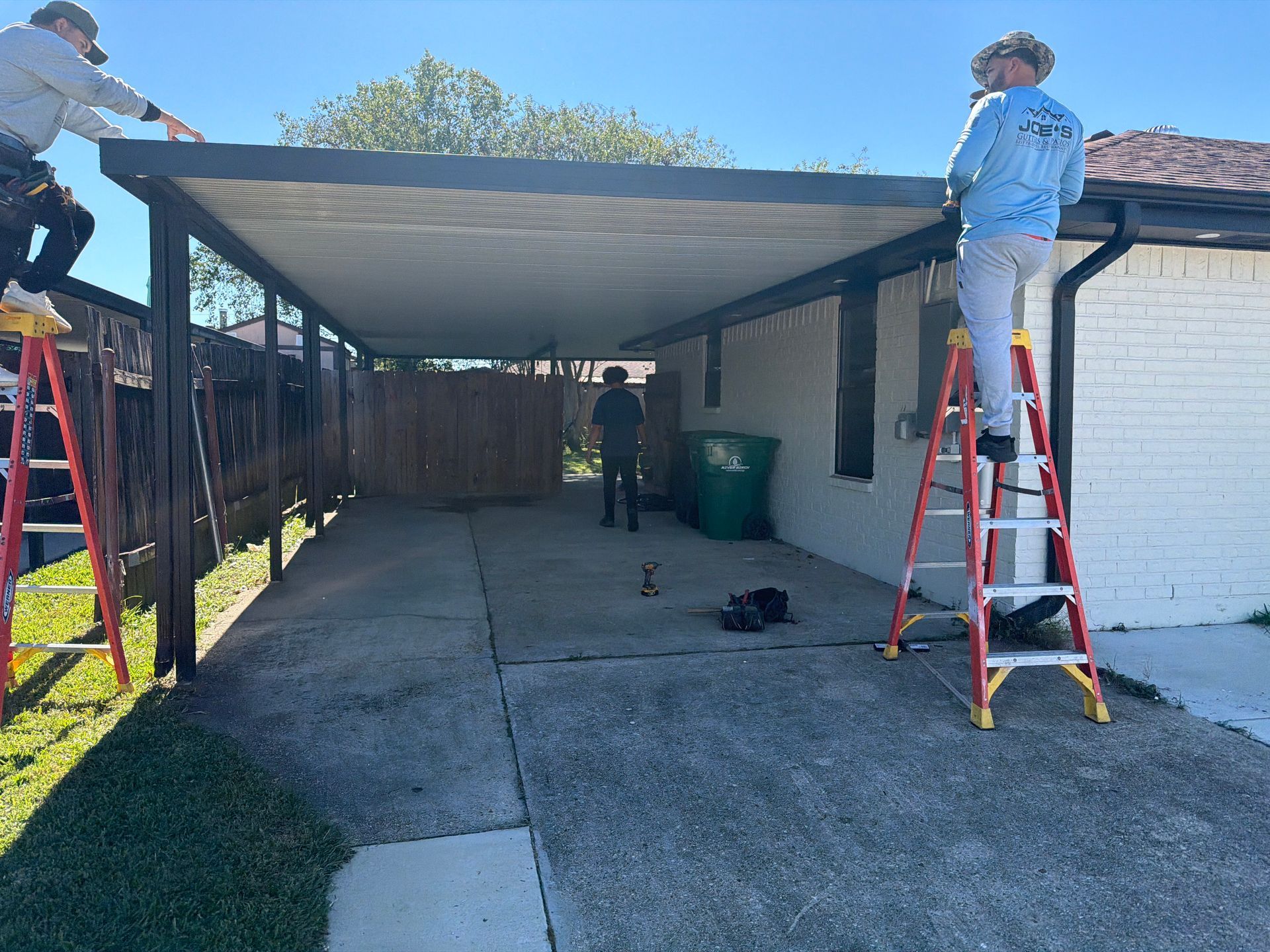
The crew's truck pulls up in the morning, and among the ladders and tools is something that surprises many homeowners: a machine that will turn a roll of flat aluminum into finished gutters right there in the driveway. Over the next several hours, a home that started the day with old, failing gutters, or none at all, ends it with a complete system formed and fitted to its exact roofline. Knowing how that day unfolds, from the first measurement to the final cleanup, takes the mystery out of the process and helps homeowners prepare for a smooth installation.
Most residential gutter installations in the Greater New Orleans area are completed in a single day, with a typical single-story home of 1,200 to 2,000 square feet taking anywhere from half a day to a full day depending on the roofline. Larger homes and complex rooflines take longer. Understanding the sequence, what the crew does, and what is expected of you as the homeowner makes the day predictable and lets you plan around it with confidence rather than wondering what is happening on your roof.
1. Before the Crew Arrives
Confirming the plan
By installation day, the important decisions are already made: the gutter size, the color, the downspout placement, and the scope of the work were settled during the estimate. A good installer provides an accurate time estimate when the job is scheduled, so you know roughly how long to expect the crew on-site. Reviewing the plan briefly with the crew lead at the start of the day confirms everyone is working from the same understanding.
Preparing the space
You can help the day go smoothly by clearing access around the perimeter of the house. Moving vehicles out of the driveway and away from the work area gives the crew room for the forming machine and ladders. Trimming back or noting any obstacles near the rooflines, opening gates for yard access, and securing pets indoors all reduce friction. The crew handles the work itself; a clear, accessible site simply lets them do it efficiently.
2. Removal and Preparation
Taking down the old system
If the home has existing gutters, the first task is removing them. The crew detaches the old runs and downspouts and clears them away. This is also the moment when any hidden problems come to light, such as fascia damage behind the old gutters that was not visible from the ground. A conscientious crew points out issues like deteriorated fascia so they can be addressed before the new system goes up, since hangers need sound fascia to fasten into.
Inspecting and prepping the fascia
With the old gutters down, the crew checks the fascia and roofline that the new system will attach to. Sound fascia is essential, because it holds the hangers that carry the gutter's load. Any preparation needed to give the new gutters a solid, correctly aligned surface to mount to happens now, before forming and installation begin. Getting this foundation right is what allows the rest of the installation to perform.
3. Forming and Installing
Custom-forming on-site
This is the part that surprises first-time homeowners. Rather than carrying in pre-cut lengths, the crew feeds coil stock through a forming machine on-site, producing each gutter run as a continuous piece cut to the home's exact measurements. This on-site forming is what makes seamless gutters possible, with no joints in the middle of a run. Watching a flat roll of aluminum become a finished gutter matched to your roofline is genuinely one of the more interesting parts of the day.
Hanging the system correctly
With the runs formed, the crew installs them with attention to the details that determine longevity. Hangers go in at tight intervals for support, the gutters are set with correct slope toward the downspouts so water drains rather than pools, corners are hand-mitered and sealed, and fasteners seal at every point. Downspouts are installed and positioned to carry water away from the foundation. Each of these steps is where a quality installation distinguishes itself from a rushed one, and where owner supervision keeps the standard consistent.
4. Final Checks and Cleanup
Testing and inspecting the finished system
Before the job is called complete, the crew checks that the gutters are level, properly sloped, and securely fastened, and that the downspouts are correctly positioned and connected. This final inspection confirms the system will drain as designed when the next rain comes. Any adjustments needed to get the slope, alignment, and attachment right are made before the crew leaves rather than discovered later.
Leaving the site clean
A professional installation ends with the site left clean. The crew removes the old gutters, gathers offcuts and packaging, and clears the work area, so the only evidence of the day is the new system on the house. Before they go, the crew lead should walk the finished installation with you, pointing out the work and answering any questions. This is your opportunity to confirm everything matches what was agreed and to understand any maintenance the new system will need.
Frequently Asked Questions
How long does gutter installation take?
A standard residential installation on a typical single-story New Orleans home of 1,200 to 2,000 square feet takes from half a day to a full day. Larger homes and complex rooflines take longer. Your installer should provide an accurate time estimate when the job is scheduled.
Do I need to be home during gutter installation?
It is helpful to be available at the start to confirm the plan and at the end for the final walkthrough, but you do not need to watch the entire process. Clearing access and securing pets beforehand matters more than being present throughout. A good crew keeps you informed of anything that comes up, such as hidden fascia damage.
Will the crew remove my old gutters?
Yes. A professional installation includes removing the existing gutters and downspouts and clearing them from the site as part of the job. This also reveals any hidden fascia problems behind the old system, which can then be addressed before the new gutters go up.
What is the machine in the driveway for?
That is the forming machine, which shapes flat coil stock into finished gutter runs on-site, cut to your home's exact measurements. On-site forming is what allows seamless gutters with no joints in the middle of a run. It is why the crew can produce continuous runs custom-fit to your roofline.
What should I do to prepare for installation day?
Clear the driveway and perimeter for ladder and equipment access, open any gates for yard access, note obstacles near the rooflines, and secure pets indoors. The crew handles the work itself; a clear, accessible site simply lets them work efficiently. A quick review of the plan with the crew lead at the start rounds out the preparation.
Frequently Asked Questions
A Predictable Day From Start to Finish
Gutter installation day follows a clear sequence: confirming the plan, removing the old system and prepping the fascia, forming and installing the new gutters on-site, and a final inspection and cleanup. Most single-story homes in the New Orleans area are finished in half a day to a full day, with larger or more complex rooflines taking longer. Knowing what each stage involves, and clearing access beforehand, lets the day proceed smoothly and gives you a finished system fitted precisely to your home by the time the crew leaves.
Joe's Gutters & Patios has been installing seamless gutters across New Orleans, Louisiana for over 20 years, custom-forming every run on-site and completing most residential installations in a single day. Because it is a father-and-son operation, the owner is personally on-site supervising the work, from the fascia inspection to the final walkthrough, rather than sending a crew you have never met. That direct oversight is how we keep the installation standard consistent and make sure the system on your home is built to perform through Louisiana's storm seasons.
Recent Posts