Pier-and-Beam vs Slab Homes: Different Gutter Drainage Needs in New Orleans
The foundation under your home decides the drainage strategy, not the gutter. Same downspout output, same New Orleans rainfall, different damage path depending on what's under your house.
A shotgun in Algiers Point sits on pier-and-beam construction with 24 inches of crawlspace beneath the floor. A 1970s ranch in Metairie sits on a concrete slab poured directly on a prepared subgrade. The same downspout discharging at the foundation produces crawlspace flooding on the shotgun and slab edge settlement on the ranch. Both develop over the years before becoming visibly obvious. Both end in repair costs in the tens of thousands.
The drainage strategy that protects each foundation is different. The same gutter system can serve both, but only with different downspout placement and discharge management.
The Foundation Decides the Drainage Strategy
Two foundations. Two completely different drainage problems.
A pier-and-beam house sits 18–36" off the ground; the air gap is the drainage. A slab house sits at grade; water has nowhere to go but out, away, or into the foundation. The gutter spec for each is different — and an installer who treats them the same will fail half their jobs.
The Side View What water actually does at each foundation
SLAB · Standing-water risk
Risk: water exits the downspout at grade and pools against the slab. In NOLA's clay soils, that water can't infiltrate fast enough. Solution: 10 ft+ extensions, ideally tied to subsurface drain to street.
PIER-AND-BEAM · Crawl-space flood risk
Risk: water gets under the house, saturates joists from below, breeds mold and rot. Solution: downspouts must clear the entire footprint — extension to the property edge or french drain perimeter.
Side-by-Side Spec What each foundation needs
| Component | Slab-on-grade | Pier-and-beam |
|---|---|---|
| Min. discharge distance | 10 ft from foundation | 15 ft (clear of footprint) |
| Preferred extension type | Solid PVC, ¼" / ft slope | Solid PVC + french drain perimeter |
| Splash blocks acceptable? | No (clay holds water) | No (water enters crawl space) |
| Sump pump required? | Sub-grade slab only | Yes if crawl space < 18" |
| Vapor barrier under house? | N/A | 6 mil minimum, sealed perimeter |
| Vent location relative to downspout | N/A | Min. 4 ft horizontal separation |
| Joe's typical install time | 1 day for avg home | 1.5–2 days (extensions + crawl access) |
Joe's quotes by foundation type — never one-size-fits-all.
Pier-and-beam construction has a crawlspace beneath the floor. Slab-on-grade doesn't. That single structural difference changes the failure mode poor drainage produces and the drainage priority your strategy has to chase.
Pier-and-beam foundations want water kept far from your perimeter. Slab wants moisture uniform around the slab edge. Two different priorities. The same gutter, two different installation outcomes.
WARNING: Both failure modes — crawlspace flooding in pier-and-beam, slab edge movement in slab construction — develop over the years before becoming visibly obvious. By the time floor joists are visibly rotted, or interior cracks are wide enough to notice, the underlying drainage has been wrong for 5-10 years. Catching the drainage problem early is the difference between a $500 downspout reroute and a $25,000 structural repair.
Pier-and-Beam Construction in New Orleans
Floor framing supported on piers — concrete blocks, brick piers, or treated wood posts — above grade, with 18 to 36 inches of crawlspace beneath. Floor joists span between the piers. A band board (also called the rim joist) wraps the perimeter, supporting the outer floor framing.
Common in pre-1940 New Orleans architectural styles: shotgun, double shotgun, Creole cottage, and camelback. The signature neighborhoods are Old Gretna, McDonoghville, Algiers Point, Garden District, Uptown, Faubourg Marigny, Bywater, and Treme — anywhere the housing stock predates the post-WWII building boom.
The crawlspace under your house is a structurally significant drainage feature. Air can move through it (crawlspace ventilation), moisture can enter it (when drainage fails), and the wood-framed floor structure sits inside it.
Slab-on-Grade Construction in New Orleans
Concrete slab poured directly on the prepared subgrade, with the floor system bonded to the slab. No crawlspace. The dwelling's framing sits atop the slab, anchored by sill plates and structural fasteners.
Common in post-1950s subdivisions: Metairie, Harvey, Marrero, Terrytown, Kenner suburbs, plus newer construction in Belle Chasse and English Turn. The signature housing stock includes ranches, split-levels, and contemporary builds from the 1990s onward.
The slab edge under your home is a structurally significant drainage feature. The slab sits on soil that expands and contracts with moisture content; the edge moves when soil moisture changes faster than the rest of the slab.
How Gutter Drainage Affects Each Foundation Differently
Same downspout output, different damage path.
Pier-and-beam crawlspace flooding is the slow-failure mode. When the downspout overflows or directs discharge toward the foundation perimeter, water finds a path under the perimeter beam and into the crawlspace. The crawlspace fills with shallow standing water that doesn't dry between rain events. Floor joists, band boards, and rim joists sit in high humidity — pushing the wood-moisture-content equilibrium above 20 percent. That's the USDA Forest Products Laboratory threshold for fungal decay activation (Morrell, 2002 — "Limiting Conditions for Decay in Wood Systems"). The damage develops hidden under the floor for years before the joists fail or the band board rots through.
Slab edge movement is the same problem from a different angle. Clay-rich soil in the Greater New Orleans area expands when wet and contracts when dry. Downspout discharge hitting the slab edge directly causes sudden saturation, while the neighboring soil remains at ambient moisture. The differential drives uneven movement. Edge heaves when wet, edge settlement when dry. Cracks form at the slab edge, propagate inward, and eventually show up as floor cracks, drywall cracks, and door/window misalignment.
| Factor | Pier-and-Beam | Slab-on-Grade |
|---|---|---|
| Common construction era | Pre-1940 | Post-1950s |
| Crawlspace | 18–36" depth | None |
| Failure mode from poor drainage | Crawlspace flooding, joist rot | Slab edge heave/settlement |
| Drainage priority | Keep crawlspace dry | Keep moisture uniform around edge |
| Best downspout placement | Storm drain or far perimeter discharge | Storm drain or extended pipe to graded discharge |
| Recovery from damage | Joist replacement, band-board repair ($5K-25K+) | Slab repair, settling correction ($10K-50K+) |
The damage cost on your home reverses the conventional wisdom that older homes are cheaper to fix. Pier-and-beam joist replacement runs $5,000 to $25,000+, depending on the extent. Slab settling correction can run $10,000 to $50,000 or more. Both are preventable with the right-sized drainage.
Pier-and-Beam Drainage Priorities
Your crawlspace must stay dry. Everything else is secondary.
Your downspout discharge must move water far enough from the foundation perimeter so that overflow can't migrate under the perimeter beam. A storm-drain connection is the cleanest option when the parish allows it. French drain at the property edge works on lots with rear-yard depth. An extended underground PVC pipe to a graded discharge point works on lots without storm-drain access.
Crawlspace ventilation matters as a backup — moving air through the crawlspace dries the wood structure between rain events. Vapor barrier under the floor framing helps, but isn't a substitute for proper exterior drainage.
TIP: Check your crawlspace once a year, ideally in late spring after the rainy season ends. Visible standing water, sagging insulation, or a musty smell mean drainage is failing. The damage develops over the years, but the diagnostic walkthrough takes 15 minutes.
Slab Drainage Priorities
Soil moisture content around your slab edge must remain uniform. Sudden swings — dry-to-wet from an undirected downspout, then drying out between rains — drive the differential movement that produces edge cracks.
The downspout strategy keeps moisture levels stable around your perimeter rather than spiking them with each rain. Storm-drain connection moves water off the property entirely. An extended underground pipe to a graded discharge keeps water off the slab edge while maintaining ambient moisture in the surrounding soil.
What doesn't work for slab: discharging at the slab edge with a splash block. The wet-dry-wet cycle is exactly what slab construction can't tolerate over time.
Hour 48-72: Contractor Estimate and Claim Documentation
The contractor visit isn't optional. The line-item scope from a Louisiana-licensed contractor is the document the adjuster will negotiate against.
What to expect from the contractor visit:
Walk-through of your damage with the contractor, who takes their own photos and notes. Written estimate with line-item scope: each section of damage with dimensions, material specifications, labor hours, and replacement cost. Documentation formatted for insurance submission — line items the adjuster recognizes, dollar totals broken out, references to industry-standard pricing.
Joe's provides this free for your assessment. Call within 72 hours for the fastest response — the post-storm queue fills up within the first day or two after landfall.
Joe's Gutters & Patios
responds to post-storm calls with priority scheduling across Greater New Orleans — free written assessments formatted for insurance documentation. Call
504-813-4293
within 72 hours for the fastest response.
TIP: Schedule the contractor estimate within 72 hours, even if you don't plan to file a claim immediately. The line-item scope is the document that anchors any future negotiation — and if damage scope grows, the supplemental claim provision under La R.S. 22:1892.2 needs the original-loss record.
The 8 Damage Categories You're Looking For
Common post-storm damage categories on gutters and patio structures:

Pulled-away gutter sections.
Wind force exceeded fastener capacity; section separated from fascia.
Separated corner joints.
Miter strips failed under flex; corners no longer water-tight.
Downspout damage.
Torn off, dented, or separated from the gutter outlet.
Fascia rot/exposure.
Underlying fascia revealed when gutter pulled away; rot may predate the storm, but is now visible.
Patio cover panel damage.
Wrinkles, dents, separations, missing fasteners.
Carport panel separation.
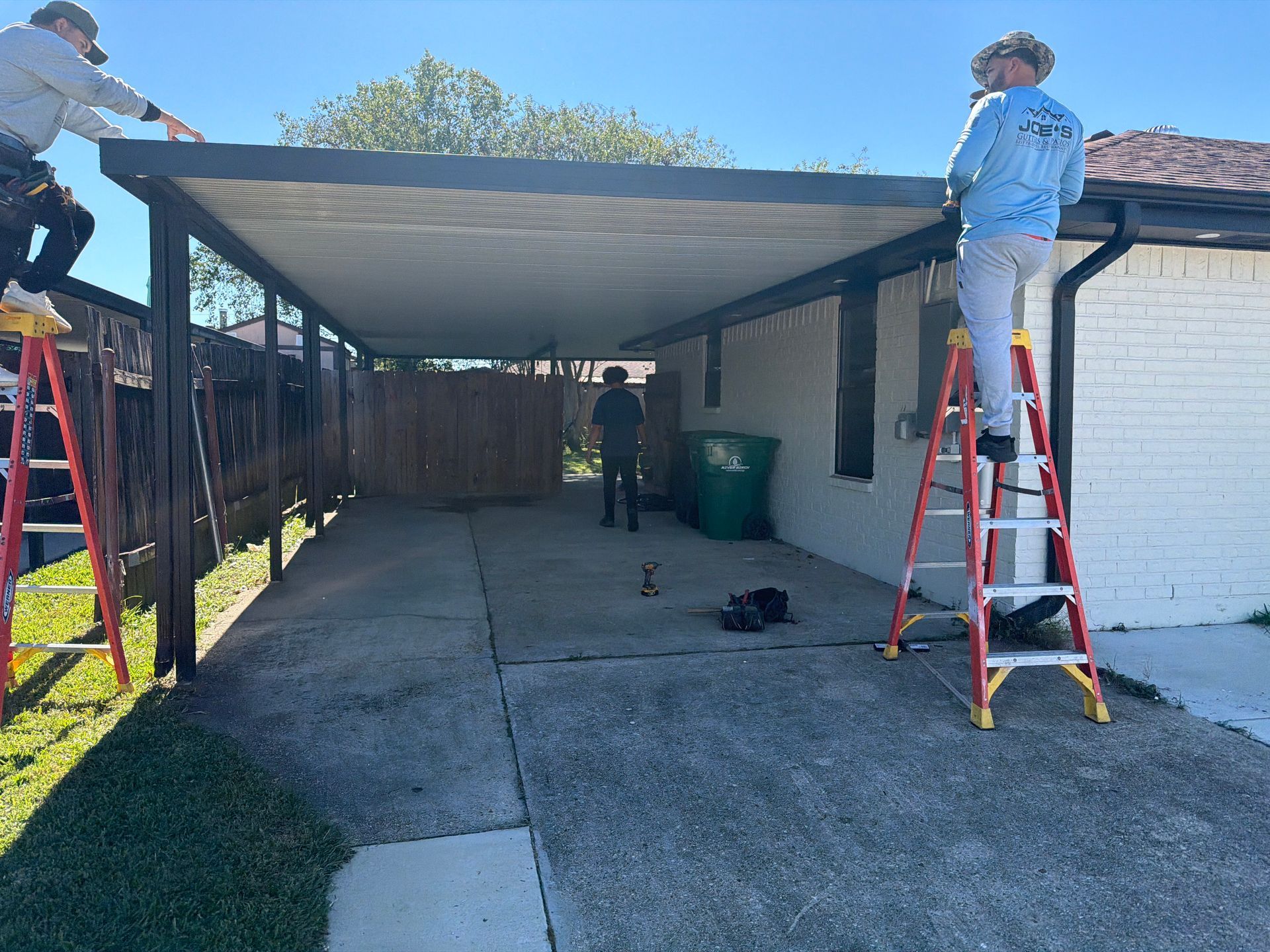
Panels detached from frame; carport may need full replacement depending on the extent.
Awning bracket failure.
Bent or pulled from wall; awning may be unsalvageable.
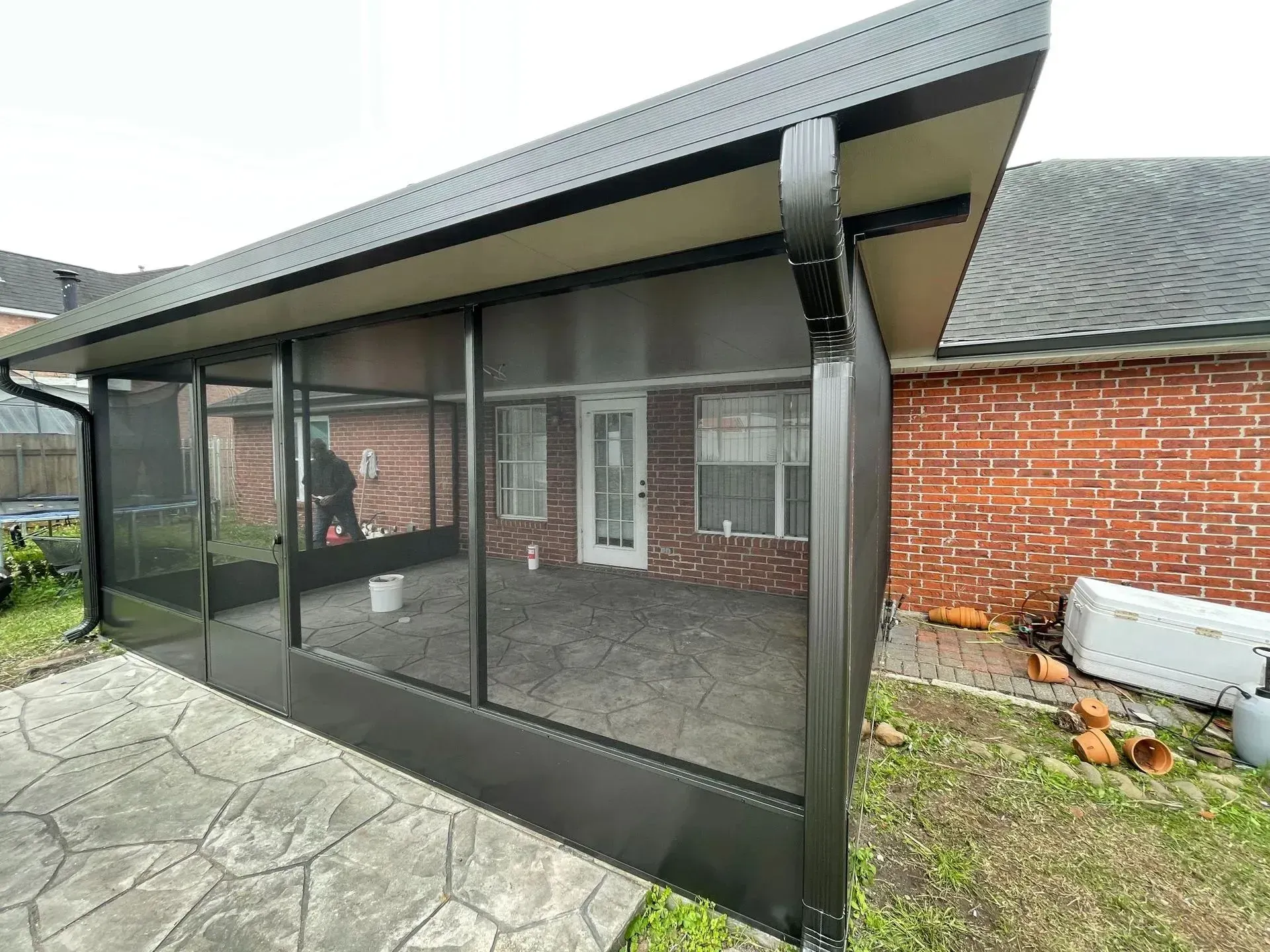
Screen-room frame damage.
Each category has a different repair scope and a different insurance treatment. Photograph each one specifically, with multiple angles and a context shot.
Frequently Asked Questions
How soon after a storm should I inspect the exterior?
Within 24 hours of safe access. The damage is freshest, EXIF timestamps on photos are closest to the storm event, and you haven't started cleanup that erases context. Safety considerations come first — confirm no electrical hazards before approaching damaged areas.
What if I find damage, but it's already raining again?
Document what you can safely. Tarp anything actively leaking before further documentation. The mitigation work itself counts — photograph the tarping, keep receipts. Wait for the next dry window for detailed inspection.
Should I do temporary repairs before the adjuster arrives?
Mitigation: yes. Tarping, diverting water, and removing dangerous debris — all required by Louisiana policy duty-of-care provisions. Permanent repairs: no. Permanent repairs before inspection are routinely cited as grounds for claim denial. Document the mitigation, leave the actual repair for after the adjuster scopes the damage.
How do I document damage I can only see from a ladder?
Hire a contractor to do the high-elevation inspection within 72 hours. The contractor's photos and notes from the ladder become part of your documentation package. DIY ladder work in post-storm conditions is high-risk; the contractor visit is the safer path.
Will my insurance cover the contractor's estimated cost?
Joe's contractor estimates for storm damage assessment are free. If you hire a paid contractor for a more detailed estimate, the cost may be reimbursable as a documentation expense under some Louisiana policies — verify with your insurer.
What if I missed the 72-hour window and waited longer?
The damage to your property is still potentially covered, but the burden of proof shifts. Document everything you can now for your file, gather contemporaneous storm records (NOAA NHC track data, news photos of regional damage), and proceed with the claim. Adjusters can still process claims documented later — they just have more grounds to question causation.
What's the difference between mitigation and repair?
Mitigation: temporary measures to prevent further damage (tarping, water diversion, debris removal). Required by policy and reimbursable when documented. Repair: permanent fixes that restore the structure (replacing damaged sections, reinstalling fasteners, repainting). Should wait until after the adjuster has scoped the damage.
The Window Closes Fast
72 hours doesn't sound like much time. It isn't.
The first 12 are safety and exterior photographs. The next 12 are the detailed inspection of the gutters and patio structures. The next 24 are interior inspections. The last 24 are the contractor visit and documentation package assembly. By hour 72, the documentation that decides your claim outcome should be complete.
Save your contractor's number before the storm. Call inside 72 hours. The post-storm queue moves fast and gets crowded fast.
72 hours is the window. Joe's Gutters & Patios
responds to post-storm calls across Greater New Orleans with priority scheduling. Call
504-813-4293
— same-day call-back, no trip fee, Louisiana contractor license #CL.65670.
Recent Posts