Door Awning Dripping on Steps: Move the Drip Line Off the Step

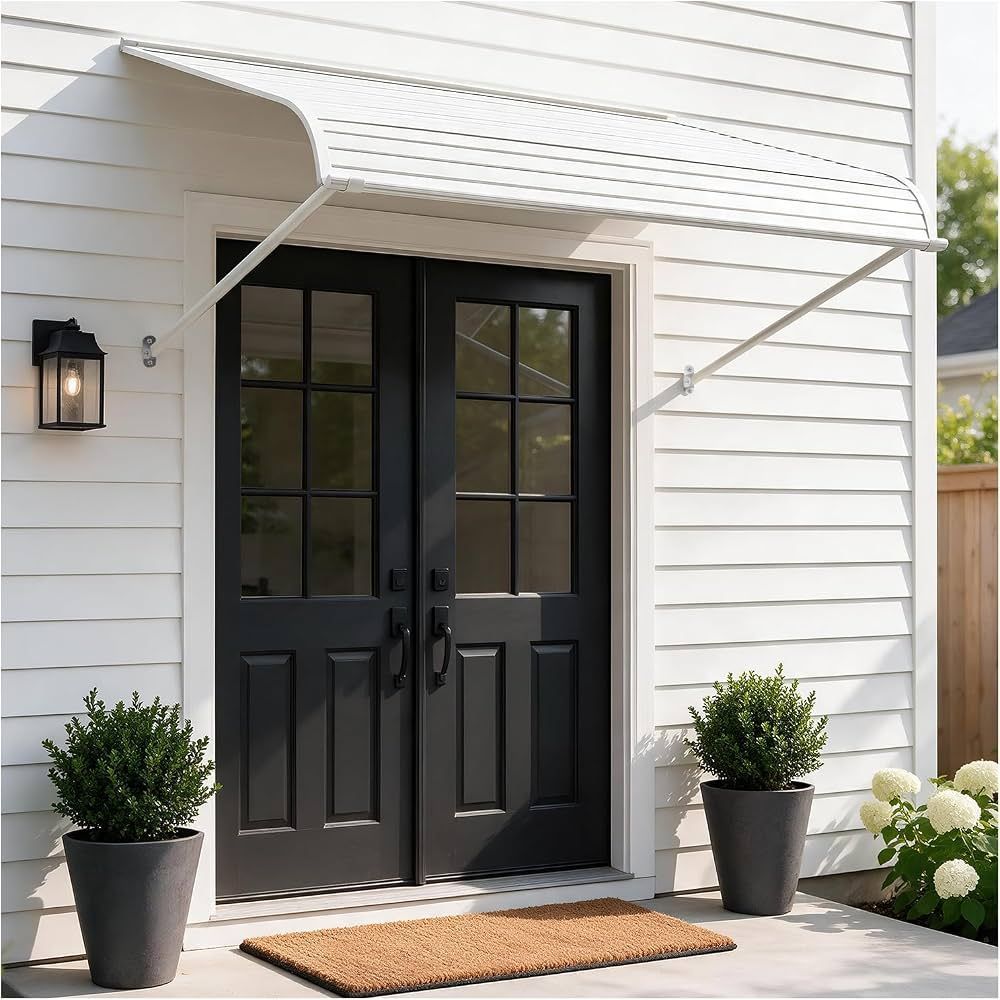
The next time it rains, stand just inside the open doorway and watch the front edge of the awning. Every drop that leaves the aluminum leaves from an edge, and the line where those drops hit the ground is the drip line. If that line crosses the top step, the awning is doing its job of catching rain and then handing all of it to the one spot you have to stand on. Two settings on the awning decide where that line falls: how far it reaches out from the wall, which is its projection, and which way and how steeply it slopes, which is its pitch. Both can be read from the ground, and both are set by the crew working at height.
Start With Where the Drops Leave the Awning
A few minutes of watching during a steady rain tells you which of the possible causes you are dealing with. Every step on this list happens with your feet on the ground or the floor of the house.
- Find the edge that drips. Note whether the water falls from the front edge, from one or both side edges, or from the wall end where the awning meets the house. Each points to a different setting.
- Mark where it lands. Once the rain stops, note whether the wet stripe sits under the front edge, beyond it, or right against the door.
- Watch the gutter over the entry. Look past the awning to the roof gutter overhead. If water is spilling over that gutter onto the awning, the awning is receiving a roof's worth of runoff on a small surface.
- Look at the wall under the attachment. Dark streaks running down the wall from the awning's top edge show water traveling down the wall surface, not off the awning.
- Photograph all of it from the ground. One photo straight on, one from the side to show the slope of the awning, and one of the wet step. Those three photos answer most of the questions the crew will ask.
Leave the awning itself alone. Pushing on the front edge with a broom, bending the edge down or tying anything to it puts load on the wall anchors and can open the seal at the attachment points.
How Projection Sets the Drip Line
In calm rain, water that runs off the front edge falls close to straight down. So the drip line sits almost directly under the front edge, and the projection decides where that is. If the step reaches farther out from the wall than the awning does, the front strip of the step sits outside the cover and catches every drop the awning collected.
Under those conditions, a 2-foot projection keeps the threshold dry. It does not reach the front of a deep landing or the second of two steps, and on those entries the shallow awning moves the drip line onto the exact spot where a person stands while opening the door. A projection in the 4 to 6 foot range covers far more of the entry, and an entry canopy is sized to reach past the front of the full step.
If the wet stripe sits beyond the awning's front edge, projection alone is putting the water there, and no reset of the existing awning moves it; a deeper awning does. Wind-driven rain is a separate question of how much depth a door needs.
Tip: Photograph the wet stripe with a tape measure lying across the step from the door, so the crew can see in one picture how far the stripe sits from the threshold and from the awning's front edge.
How Pitch Decides Which Edge Sheds the Water
A fixed aluminum awning slopes down and away from the wall so that rain runs to the front edge and leaves there. That slope is the pitch. When the pitch is right, almost all the water travels to the front and drops off in a line, and the side edges stay close to dry.
Two pitch problems put water on the step even when the projection is generous.
Too little slope: Water that barely moves spreads across the panel and finds the side edges before it reaches the front. On a near-flat awning, a gust can push that slow sheet back to the wall end, where it slips past the top edge and falls on the step from under the cover.
Slope toward the wall: If an attachment point loosens or the awning has settled, the front edge can end up level with the wall end or higher. Then the pitch sends rain backward, toward the house, where it runs down the wall and the door face and lands on the top step right at the threshold. Wall-end drips from step 1 fit this case, though a near-flat pitch or water running down the wall can leave the same drips, so the crew checks the slope before re-anchoring.
Water pouring off all three sides at once comes from a pitch too flat to steer it, or from more water landing on the awning than it can carry to the front edge. Water dripping from only one side edge can trace to an awning that has dropped on that side, and the crew also checks the front edge for a dent that blocks the flow. Resetting the pitch means loosening, shimming or re-anchoring the awning at the wall, and that is ladder work for the crew.
Water That Reaches the Awning From Overhead
Some awnings drip onto the step because they are handling more water than the rain that falls on them. A roof gutter running over the entry that overflows, or a roof edge with no gutter at that spot, pours roof runoff straight onto the awning. A small awning cannot carry that volume to its front edge, so it sheets off the sides and splashes off the surface onto the step.
A gutter that spills over its lip above the entry turns the awning into a second gutter, and in that case the repair belongs on the gutter. If the gutter overhead spills in a downpour, a cleaning and a check of its pitch and outlet are the first move, because a reset awning still drips if a roof's worth of water lands on it.
Walls can carry water too. A wall with no eave or gutter over the awning lets runoff travel down the face of the house and reach the top of the awning at the attachment line, where it either runs onto the awning or down behind it.
Keeping the Step Safe Until the Fix
A wet step under a dripping edge is slippery. Until the crew changes the awning:
- Put a ribbed outdoor mat on the landing, back from the drip line so the mat itself stays dry.
- Step through the drip line in one stride and plant your foot on the dry part of the landing.
- Keep packages, planters and shoes off the wet stripe so nobody stops on it.
- Use the side or back door in a long, heavy rain if that entry stays drier.
Warning: Do not set a ladder on wet entry steps to reach the awning or the gutter over it. The crew sets ladders on stable ground and handles any re-anchoring, pitch reset or gutter work over the door.
When to Call the Crew
Bring the crew in when the wet stripe sits beyond the awning's front edge, when the drip comes from the wall end or one corner, or when water reaches the awning from an overflowing gutter overhead. Any of those needs work at the wall or the roof edge.
What the crew can do falls into three changes. A deeper awning moves the drip line out past the step. A pitch reset at the wall, with the attachment points re-sealed, sends water back to the front edge. Gutter cleaning or repair on the run over the entry cuts the volume landing on the awning. On some entries more than one cause is at work, and the crew checks the gutter before deciding whether the awning needs to change at all.
Have your photos and the note of where the wet stripe sits ready, and note the wall material behind the awning. That shortens the visit and lets the crew judge whether the existing awning can be reset or whether the projection is the real limit.
An awning moves rain from one place to another. Where it sets the water down depends on how far it reaches and which way it leans, and a step that stays wet in every rain is pointing at one or both.
Frequently Asked Questions
Is the awning dripping, or is the water coming down the wall?
Watch the attachment line after the rain stops. The awning surface stops running within minutes, so drops that keep falling from under its top edge after that are coming out of the wall along the anchors. The crew re-seals those attachment points.
What if the steps are wider than the awning?
Then the ends of the steps sit outside the side edges, and anything that drips off a side lands there. A wider awning, or a pitch that keeps the water moving to the front edge, keeps the side drips off the step.
Can a steady drip on the step damage the door?
Yes. Water splashing up from the step and running over the door keeps the lower jambs, the bottom of the door and the hardware wet, which wears them out early and can let water into the joint behind the trim.
Could a downspout next to the steps be adding to the water?
It can. A downspout that empties onto the walk or the ground by the steps spreads water toward the landing. An elbow and extension, or a splash block, directs that discharge away from the entry so the step only sees what the awning drops.
Will a replacement awning match my gutters?
Fixed aluminum awnings come in six baked-enamel colors. Gutters or a cover the same crew put up earlier can be matched exactly. Beside another installer's work, color samples come to the house so the nearest shade can be picked.
How long does an aluminum awning last once it is sized right?
An aluminum awning has a lifespan of 20 years or more, and the upkeep is an occasional rinse with a hose. Sizing the projection and pitch correctly at the start is what keeps the step dry through all of those years.
Put the dripping step on the crew's list — they compare the awning's projection and pitch with your step and move the drip line off it. Joe's Gutters & Patios serves Gretna and the Greater New Orleans area. Call (504) 813-4293.
Get Free Estimate Call 504-813-4293Recent Posts